
On November 8-10, 2024, sponsored by the Clinical Microbiology Committee of the Shanghai Society of Microbiology, the Medical Microbiology Committee of the Shanghai Society of Microbiology, the Microbial Resistance Prevention and Control Committee of the Shanghai Society of Microbiology, and the Medical Mycology Committee of the Shanghai Society of Microbiology, Huashan Hospital Affiliated to Fudan University, Ruijin Hospital Affiliated to Shanghai Jiao Tong University School of Medicine, Renji Hospital Affiliated to Shanghai Jiao Tong University School of Medicine, The 10th International Forum on Clinical Microbiology and Infectious Diseases and the 7th Summit Forum on the Prevention and Control of Microbial Resistance hosted by the East Hospital of Tongji University were successfully held. On November 9th, Professor Zhu Demei from Huashan Hospital Affiliated to Fudan University hosted the meeting, and Professor Hu Fupin gave a special speech to discuss the clinical pain points and solutions for the rapid diagnosis of severe carbapenem-resistant bacteria (CRO) infection.
Professor Zhu Demei: In the fight against CRO, rapid diagnosis and treatment is urgent
Professor Zhu Demei pointed out that drug-resistant bacteria cause more than 1 million deaths every year worldwide, with an additional expenditure of more than 400 billion US dollars per year, seriously endangering global public health and economic growth. CRO infection treatment drugs are very limited, and it is a key priority pathogen recommended by the WHO for the urgent need to develop new drugs. For patients with CRO infection, early and appropriate initial antibiotic therapy can effectively reduce the mortality rate of patients, and it is necessary to rationally apply rapid detection methods to accelerate early diagnosis and precise treatment and reduce patient mortality.
Prof. Hu Fupin: Rapid enzyme type and rapid antimicrobial susceptibility test accelerate the early diagnosis and precision treatment of severe CRO
At present, the detection rate of key CRO bacteria in China [such as carbapenem-resistant Klebsiella pneumoniae (CRKP)] still maintains a high detection rate, and the detection rate of isolated bacteria in patients in intensive care medicine departments of some hospitals exceeds 40%, which is much higher than that of other departments, and the case fatality rate of CRO infection can be as high as 30%. In patients with severe CRO infection, antibiotic therapy was given 1 hour later was associated with a 35% increased risk of death, and early inappropriate initial antibiotic therapy increased the risk of death by 348%. Due to the long time taken by traditional culture testing, it takes at least 24~48 hours from receiving the sample to be tested to complete the identification, and the reporting time of drug susceptibility test results can reach 72 hours, and the positive rate of culture results is low (such as the positive rate of blood culture is less than 20%), which delays the best treatment time for patients in the early stage, and more rapid and accurate detection methods are urgently needed to accelerate the early diagnosis and precise treatment of CRO.
In the face of severe CRO infection, clinicians should send microbial samples for testing as much as possible before applying antimicrobial drugs, and actively search for pathogens to carry out targeted treatment. The clinical microbiology laboratory actively explores new technologies for rapid diagnosis to improve the efficiency of diagnosis of infectious diseases and promote the precise use of antimicrobial drugs. For high-risk patients with a bloodstream infection that may be caused by a drug-resistant infection and who are also associated with severe sepsis or septic shock, it is recommended that blood cultures be sent along with rapid resistance genetic testing (e.g., CRO enzyme testing) or rapid drug susceptibility testing.
The CRO rapid enzyme type test can advance the treatment time by about 23 hours, and the proportion of optimal antimicrobial treatment can reach 95%. Rapid enzyme type detection includes colloidal gold immunochromatography, PCR, NGS and other methods, among which colloidal gold immunochromatography can report the results of carbapenemase enzyme detection within 15 minutes, with a sensitivity of 97.6% and a specificity of 100%. Digital PCR has higher detection sensitivity and accuracy, can detect pathogenic bacteria and drug resistance genes directly from the specimen, and can report the test results within 2 hours. Studies have confirmed that early carbapenemase zymotype detection based on PCR and NGS sequencing technology can significantly advance the reporting time of carbapenem-resistant Enterobacteriaceae (CRE) detection, promote the early clinical initiation of effective anti-infective therapy, and bring good news to infected patients, such as a 65% reduction in the 30-day mortality risk of KPC-producing patients with Klebsiella pneumoniae infection.
The rapid antimicrobial susceptibility test is at least 6~12 hours faster than the existing traditional antimicrobial susceptibility test results, especially suitable for fast-growing bacteria. The study showed that the rapid antimicrobial susceptibility test results of positive blood culture specimens were highly accurate, and the coincidence rate with the results of traditional gold standard antimicrobial susceptibility test was 98.7%. Studies have confirmed that rapid antimicrobial susceptibility testing can shorten the average hospital stay of patients with drug-resistant infections by 5.5 days, which can help save medical costs and improve patient outcomes. Real-world surveillance data have shown that ceftazidime avibactam is more than 99% susceptible to Klebsiella pneumoniae in KPC. A real-world study in China also confirmed that for critically ill patients with CRKP infection, ceftazidime avibactam treatment can effectively improve the prognosis and survival rate of patients, and reduce the risk of death by 61%.
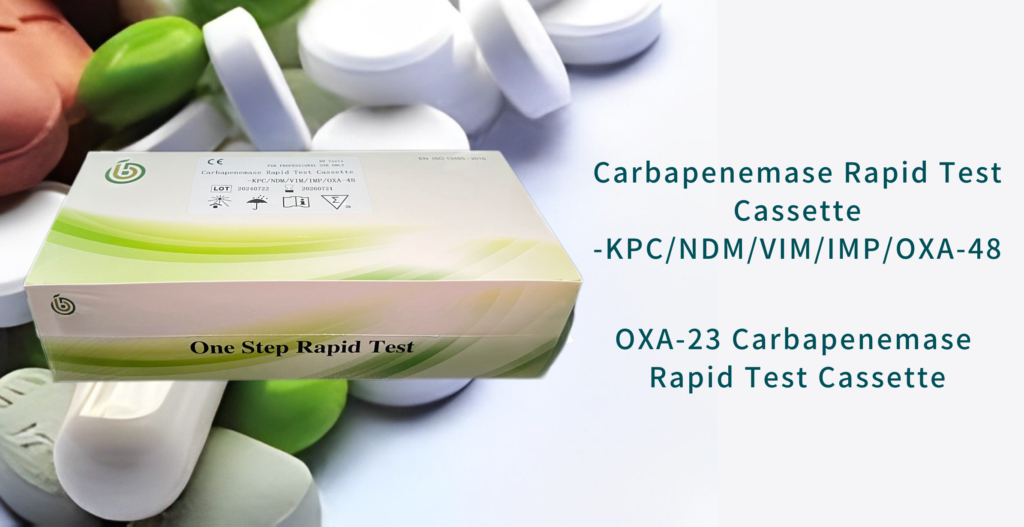
On this topic, our company has CRE products to help people get faster and more accurate tests and results.
Carbapenemase Rapid Test Cassette-KPC/NDM/VIM/IMP/OXA-48
In vitro rapid diagnostic test for the detection of KPC, NDM, VIM, IMP, OXA-48, carbapenemases in bacterial culture to help diagnose infection.Carbapenemresistant Enterobacteriaceae(CRE) represent a major public health concern worldwide due to their broad spectrum of resistance to antibiotics including, besides carbapenems, most classes of antimicrobial agents, and thus leaving very few options for the management of infected patients.
OXA-23 Carbapenemase Rapid Test Cassette
The OXA-23 Carbapenemase Rapid Test Cassette is In vitro rapid diagnostic test for the detection of OXA-23 carbapenemase in bacterial culture to help diagnose infection.
Acinetobacter baumannii is an important opportunistic and multidrug-resistant Gramnegative bacterium responsible for nosocomial infections in health facilities. If left untreated, this infection can lead to septicemia and death. The carbapenemhydrolysing oxacillinases (OXAs) are the most commonly reported carbapenemresistance determinants in Acinetobacter spp., particularly in A. baumannii. Among the OXAs, OXA-23 is the most prevalent carbapenem-resistance determinant in A. baumannii isolates.
Summary
The high incidence of CRO infection and the high case fatality rate in severe patients require multidisciplinary cooperation such as clinical, pharmaceutical, laboratory and infection control to drive early diagnosis and precise treatment of CRO. Rapid enzyme type, rapid antimicrobial susceptibility testing and combined antimicrobial susceptibility testing technology can accelerate early diagnosis and precision treatment, reduce patient mortality and improve prognosis. In order to further improve the treatment effect of patients, under the guidance of rapid diagnosis technology, effective antibacterial drugs such as ceftazidime avibactam and other antibacterial drugs should be used rationally for early treatment, so as to reduce the mortality rate of infected patients.